
Aryan Rana posted an update in the group Economy & Industry Triggers
9 months, 2 weeks agoGST Collection for May 2025: Robust Growth Signals Economic Momentum
India’s gross Goods and Services Tax (GST) collection surged by 16.4% in May 2025, reaching ₹2,01,050 crore, according to official data released on Sunday. This marks a significant jump from ₹1,72,739 crore collected in May 2024.
The strong year-on-year growth was supported by increased collections across all major components — Central GST (CGST), State GST (SGST), Integrated GST (IGST), and Compensation Cess.
April–May 2025-26 Performance
For the first two months of the financial year 2025–26, cumulative GST collections have reached ₹4,37,767 crore, a 14.3% increase over the ₹3,83,006 crore collected during the same period last year.
This performance underscores the underlying strength of domestic consumption, improved compliance, and buoyant import activity, pointing towards sustained economic momentum.
Economic Significance
The robust collections reinforce confidence in India’s economic recovery, fiscal resilience, and tax compliance systems. The growth in GST revenue provides vital support for public expenditure and long-term infrastructure development.
GST Implementation and Council Oversight
Since its rollout on July 1, 2017, GST has aimed to streamline indirect taxation across India. States were compensated for any revenue losses during the first five years under the GST (Compensation to States) Act, 2017.
The GST Council, chaired by the Union Finance Minister and comprising State Finance Ministers, plays a key role in rate rationalization and tax governance. The most recent Council meeting was held on December 21, 2024, in Jaisalmer, Rajasthan.
Consumer Impact
GST rate reductions and exemptions on essential and household items have directly benefited consumers. Key items with reduced or zero tax rates include:
• Essential Commodities: Wheat, rice, curd, lassi, buttermilk
• Personal Care Products: Hair oil, toothpaste, soap
• Home Appliances: TVs (up to 32″), refrigerators, washing machines
• Electronics: Mobile phones
• Daily Use Goods: Detergents, washing powder
Key Observations:
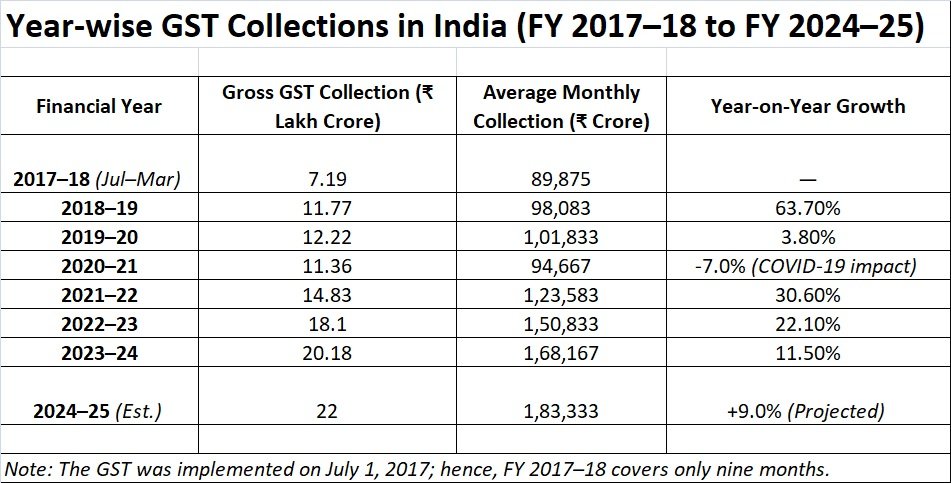
• Steady Growth: Since its implementation, GST collections have shown a consistent upward trajectory, reflecting the broadening tax base and improved compliance.
• COVID-19 Impact: FY 2020–21 witnessed a decline due to the pandemic’s economic disruptions. However, the subsequent years saw a robust recovery.
• Record Collections: FY 2023–24 recorded the highest annual collection of ₹20.18 lakh crore, indicating strong domestic consumption and effective tax administration.
• Projected Growth: For FY 2024–25, collections are estimated to reach ₹22 lakh crore, marking a projected growth of 9% over the previous year.
Factors Contributing to GST Collection Trends:
• Economic Recovery: Post-pandemic economic activities have bolstered tax revenues.
• Enhanced Compliance: Implementation of e-invoicing and stringent measures against tax evasion have improved compliance rates.
• Policy Reforms: Periodic rate rationalizations and policy decisions by the GST Council have streamlined the tax structure.